Jun 9 • Alan Salari

Why Real-Time Visibility Matters More Than Ever in Modern RF Development

Today's RF systems are more complex, distributed, and
interconnected than ever before. Yet many engineering teams
still struggle with limited visibility into their measurement
environments, test setups, and operational data.

When engineers cannot see what is happening in real time,
small issues often become costly delays.

01 

What is Real-Time Visibility in RF Testing? 

─── 

In RF testing, visibility means the ability to see, understand, and act on what is happening across a measurement environment in real time.

It is about knowing what is being measured, how the setup is configured, what data is being produced, who is involved, and whether the results make sense.

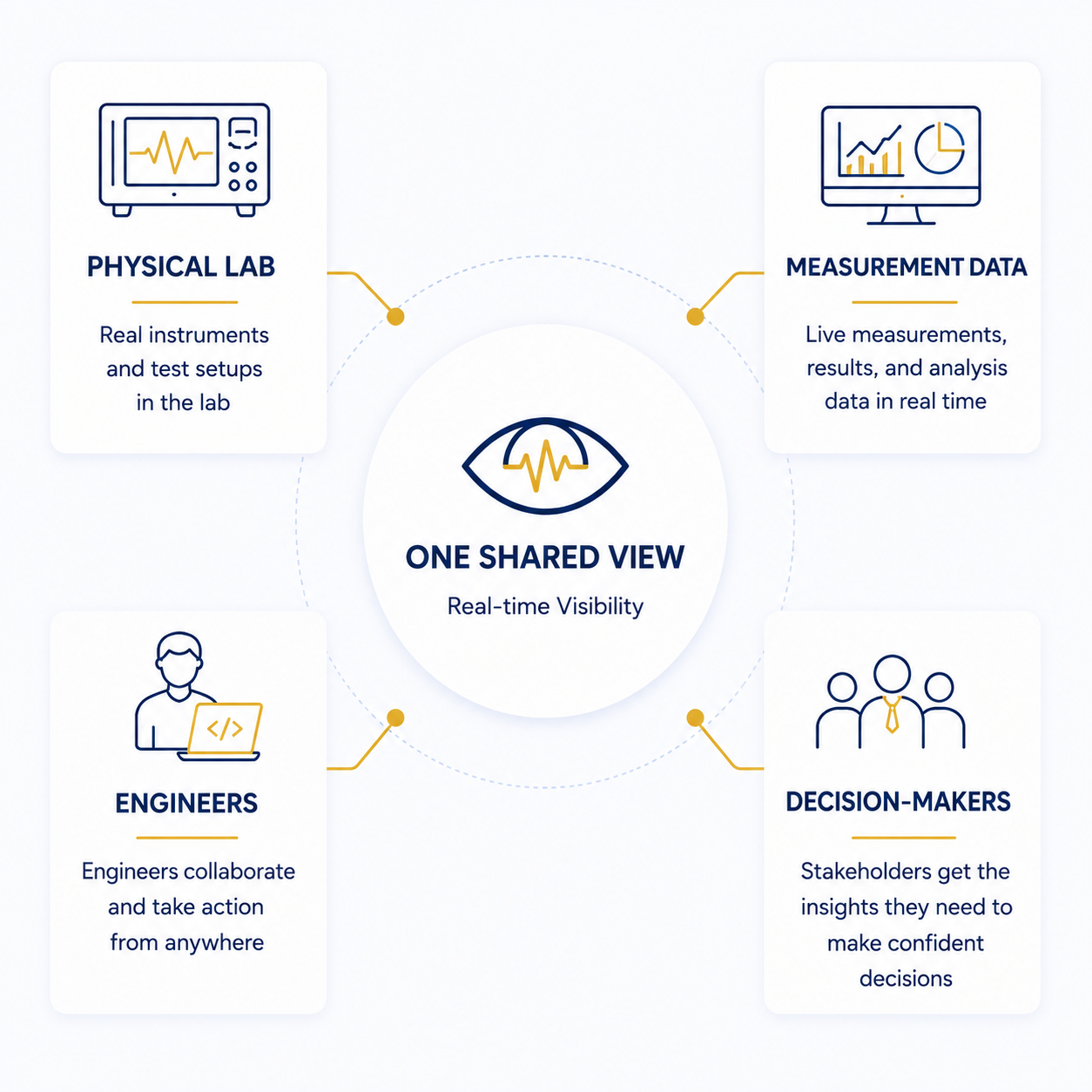
True visibility connects the physical lab, the measurement data, the engineers, and the decision-makers into one shared view.

Write your awesome label here.

02

The Problem

─── 

The lack of visibility affects RF organizations in different ways, but the underlying challenge is often the same:

People cannot see what is happening when and where it matters most.

Let's look at two very different scenarios.

Production Line

─── 

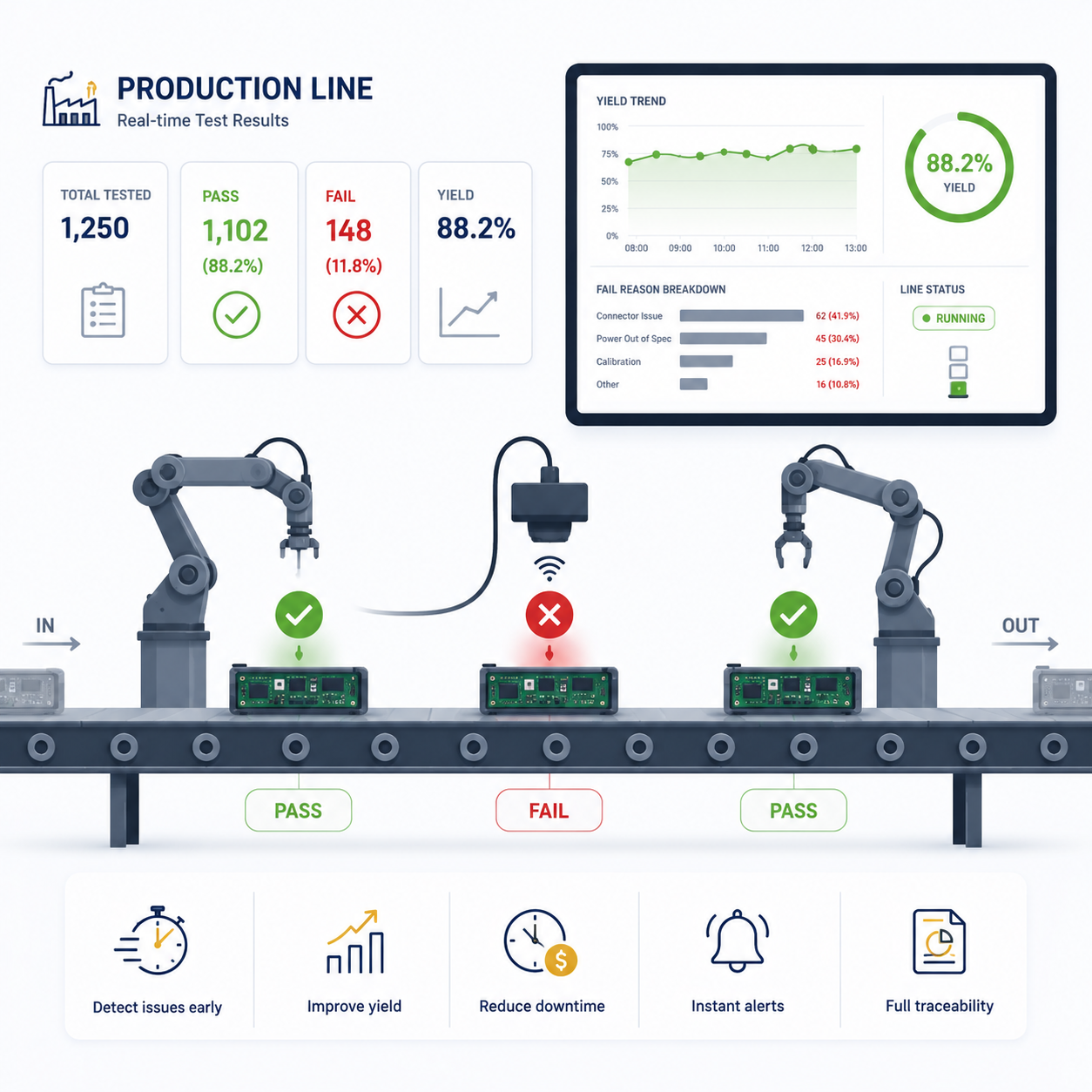
Imagine a production line testing hundreds or thousands of RF products every day. A unit suddenly starts failing. The yield drops. Production slows down. Operators know there is a problem, but they do not necessarily know why.

In many organizations, the next step is to wait for an engineer or specialist to investigate. 

This may require traveling to the facility, reviewing logs, reproducing the issue, and performing additional measurements before a root cause can be identified. During this time, production continues to suffer.


The problem becomes even more difficult when managers and engineers do not have real-time visibility into production yield, pass/fail rates, test results, or equipment status.

Consequences

─── 

Production downtime resulting in lost revenue and delayed deliveries

Engineering resources spent troubleshooting instead of developing products

Travel costs including transportation, hotels, and lost working hours

Slower response times and longer recovery periods

Lab Testing

─── 

Now consider a completely different environment: an RF development laboratory.

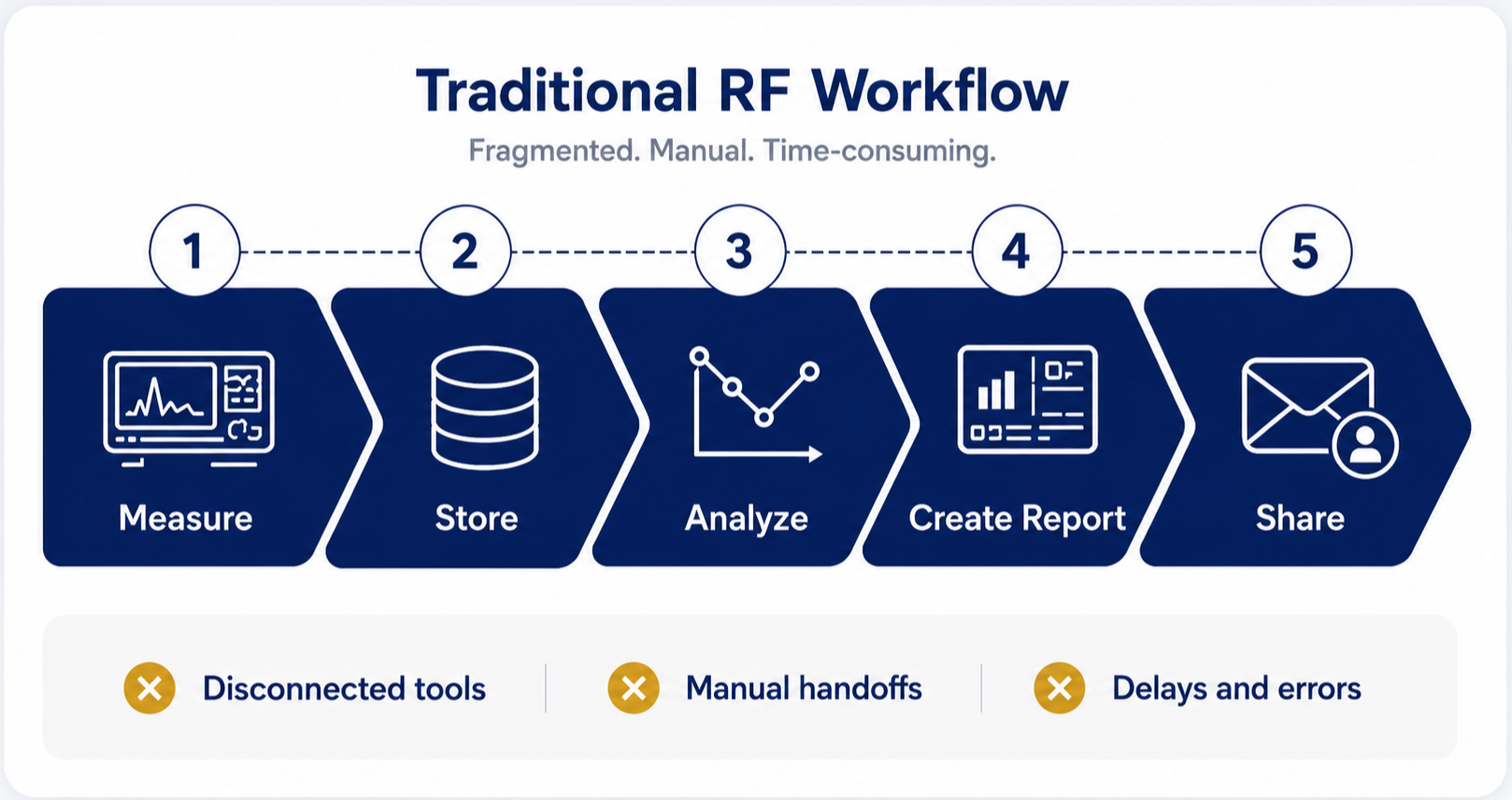
An engineer performs a measurement on a prototype and follows the standard workflow:

1. Perform the measurement

2. Save the data

3. Analyze the results using MATLAB, Python, or other tools

4. Create plots and reports

5. Share findings with the team


At first glance, this process appears reasonable. The problem arises when the measurement was performed incorrectly. Perhaps a cable was connected incorrectly. Perhaps the calibration was not performed properly. Perhaps the wrong instrument settings were used. Perhaps the measurement itself does not answer the question the team is trying to solve.

Only after the results are reviewed does someone realize the problem. The entire process must then be repeated.

New measurements are taken. New reports are generated. New meetings are scheduled. Days can be lost simply because the right people could not see the measurement while it was happening.

Consequences

─── 

Lost engineering time due to incorrect test setups

Delays between measurement and decision-making

Slower collaboration between experts and stakeholders

Repeated testing cycles that increase project cost and schedule risk

In both examples, the issue is not the lack of instruments, data, or expertise.

The issue is the lack of visibility.

03

Why The Obvious Solutions Fail

─── 

Over the years, organizations have tried to improve visibility using documentation, screenshots, emails, spreadsheets, shared drives, presentations, and remote desktop tools. While these approaches access to information, but they did not create real-time visibility. Most importantly, critical context is often missing for the measurements. 

Documentation

  • What exactly was measured?
  • What was the test setup?
  • Which instrument settings were used?
  • How was the issue eventually solved?

Knowledge Silos

  • Knowledge remains trapped within individuals.
  • When experienced engineers leave, much of their expertise leaves with them.
  • Teams are forced to spend time rediscovering solutions to problems that were already solved years earlier.

Remote Desktop

  • Remote desktop creates access.
    It does not create visibility.
  • Typically, only one person can control the system at a time.
  • Observation, collaboration, and real-time decision-making remain difficult.

Current Solutions act as painkillers

─── 

  • The result is a fragmented workflow where measurements, data, expertise, and decisions remain disconnected.
  • The symptoms may improve, but the root cause remains.
  • These solutions act as painkillers.
  • They reduce some of the discomfort, but they do not cure the disease.

The Root Cause Remains

─── 

The physical lab, the measurement data, the engineers, and the decision-makers are still
not connected through a shared real-time view.

04

A Better Approach

─── 

Instead of treating visibility as an afterthought, organizations need to treat it as part of their RF infrastructure.

Just as modern companies invest in test equipment, software tools, and automation, they must also invest in systems that make measurements, data, and expertise accessible in real time.

─── 

Real-Time Access

Access instruments anywhere and observe measurements, results, and system status as they happen

─── 

Centralized Data

Store measurement data, test configurations, and results in one location

─── 

Remote Collaboration

Enable engineers, managers, and subject matter experts to work together in real-time regardless of location

─── 

Shared Visibility

Give everyone access to the information they need to make better decisions faster.

The Quaxys Vision

─── 

  • Secure remote access to RF instruments.
  • Live measurement visibility
  • Collaborative workflows
  • Distributed teams working as on
Write your awesome label here.

05

The Result

─── 

When visibility improves, organizations move faster.
Problems are identified earlier, collaboration happens in real time, and decisions are made with confidence.

Without Visibility

─── 

  • Problems discovered late
  • Travel required
  • Measurements isolated
  • Knowledge trapped in individuals
  • Slow decisions
  • Downtime and delays

With Visibility

─── 

  • Problems identified early
  • Remote collaboration from anywhere
  • Shared measurements in real time
  • Knowledge captured and retained
  • Faster decisions
  • Continuous operation

The Benefits Extend Across the Organization

─── 

─── 

Reduced Downtime

Resolve issues faster and keep operations running.

─── 

Lower Travel Costs

Reduce site visits and associated expenses.

─── 

Faster Delivery & Decisions

Move from measurement to decision in less time.

─── 

Knowledge Retention

Capture expertise and reduce dependency on individuals.

─── 

Better Customer Demos

Deliver more effective demonstrations and technical reviews.

Focus on What Matters

─── 

Engineering teams spend more time solving problems and creating value, and less time searching for information, recreating measurements, or waiting for answers.

Key Takeaways

─── 

When visibility improves, organizations move faster.
Problems are identified earlier, collaboration happens in real time, and decisions are made with confidence.

─── 

Accelerate Development

Visibility enables teams to identify issues earlier, reduce delays, and move projects forward faster.

─── 

Enable Distributed Teams

Connected infrastructure allows engineers, managers, and experts to collaborate from anywhere.

─── 

Move Beyond Information

Documentation and remote access provide information. True visibility provides context, collaboration, and insight.

─── 

Gain a Competitive Advantage

Organizations that improve visibility reduce downtime, improve productivity, and make better decisions.

See Faster  Understand Faster  Act Faster

─── 

Visibility is becoming a fundamental requirement for modern RF organizations.

ABOUT THE AUTHOR

───

ALAN SALARI

Founder of Quaxys  RF & Quantum Hardware Engineer  Author

─── 
Alan Salari's work spans RF systems, superconducting quantum computing hardware, radar, satellite communications, and advanced measurement technologies.

As the author of the three-volume Modern RF Product Development series and Microwave Techniques in Superconducting Quantum Computers (Artech House),

Alan is passionate about helping engineers bridge the gap between theory and practice. His work focuses on developing the technical judgement, measurement confidence, and system-level thinking needed to build impactful RF and quantum technologies.
Created with